Elementary Fact Expression
 Instead of explaining the ins and outs of elementary fact expressions, this article is a copy of the dialog held with ChatGPT about it. It was very quickly catching on, and along the way learned how to correct the mistakes. It is a very insightful session, and we consider it to be of help to our novice readers. Enjoy the read, and let us know what you think. (The article is only altered in layout to break down the directions in which the session heads.)
Do you know what an elementary fact expression is?
I'm not certain what you mean by "elementary fact expression," as the term is not a commonly used one in natural language or in any specific field of study. Can you please provide more context or information so I can better understand what you are asking?
Tables and Views
Are you looking for an effective way to represent your business data? Database views are the perfect solution! A database view is a select statement that is run on tables to fetch meaningful data for some application. With views, you can easily represent meaningful business concepts. But which business concepts should be represented by tables, and which by views?
NIAM, ORM and FCO-IM
The added value of FCO-IM over other Fact-based Methods, for the business is its direct anchoring in business communication, which makes models easier to validate, more traceable, less biased, and more adaptable. This reduces risk, increases stakeholder involvement, and improves compliance — all of which translate to lower project costs and higher business confidence in IT outcomes.
FCO-IM in One Slide
FCO-IM explained in a single image. From natural language communication to system design and implementation.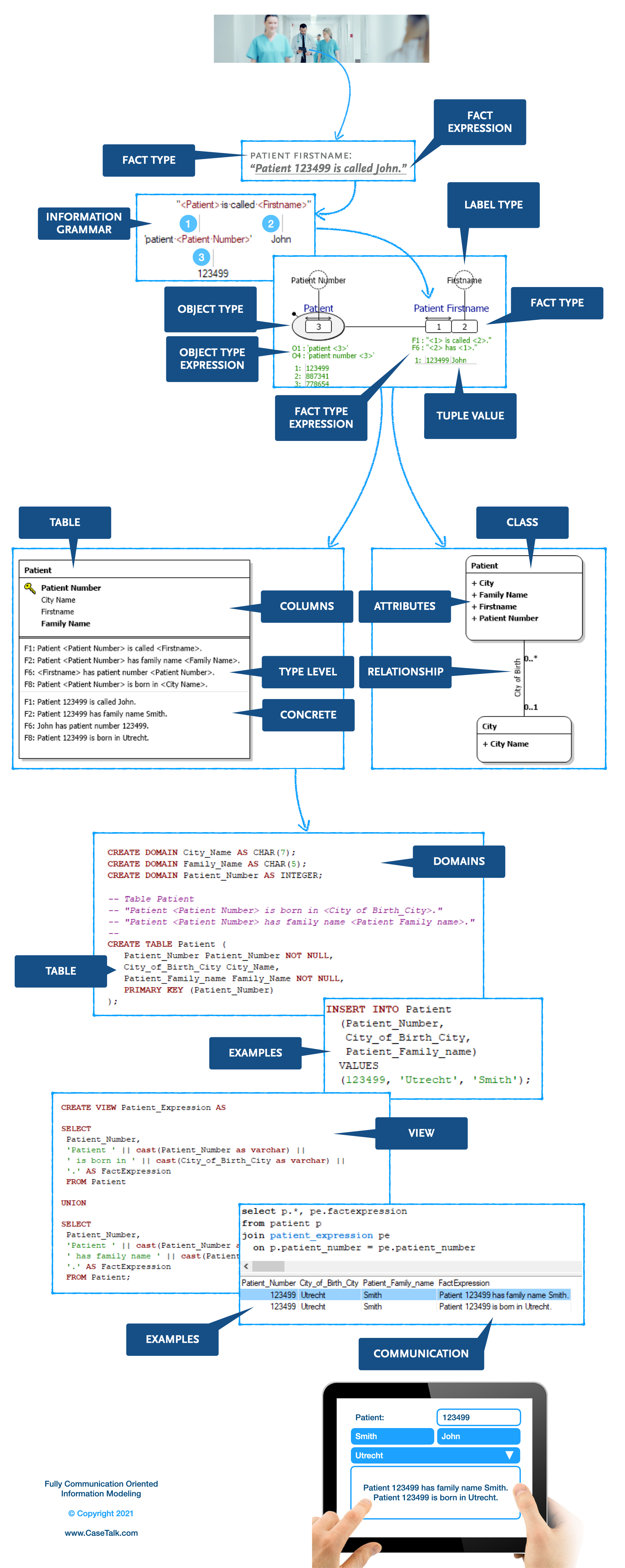
Short Modeling Tutorial
This example is also given as an example with the CaseTalk download. This example demonstrates the method of information modeling using CaseTalk.


Scheduled
-
3 days - Fact Based Modeling with CaseTalk
February 18, 2026 9:00 am